

















Common Types of Profile Steel and Their Fields of Use
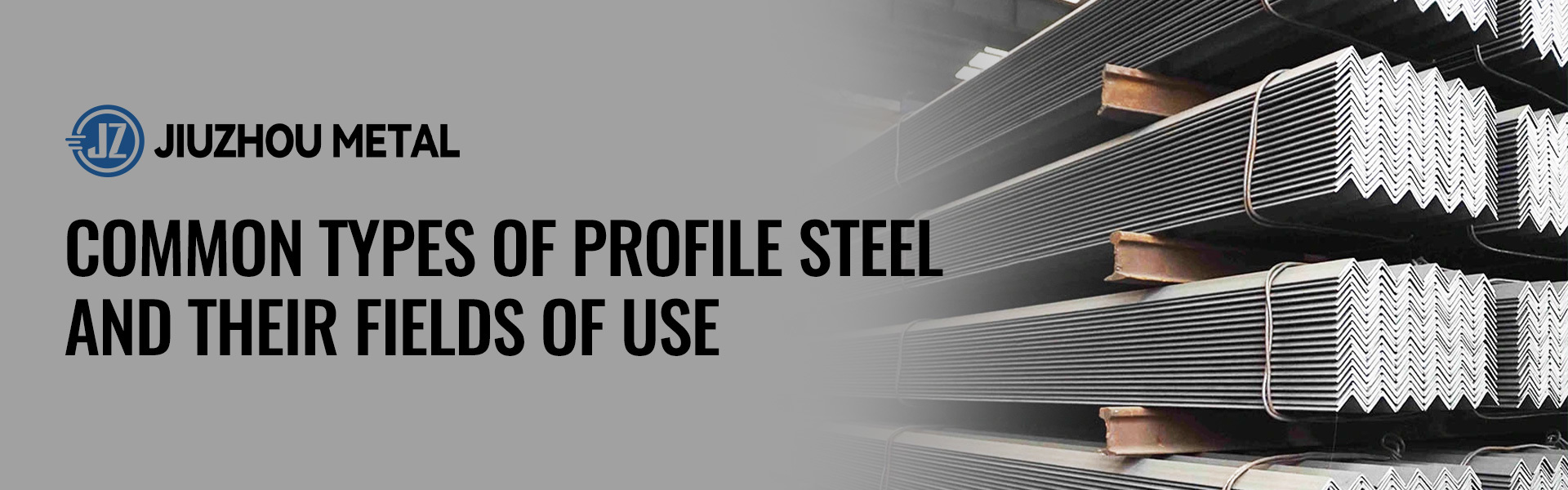
Profile steel is a kind of steel with a specific cross-section shape, which is widely used in construction, engineering, manufacturing and other fields. Profile steel has many advantages including stable structure, high strength, light weight, convenient processing, etc.. So it is widely used in various industries. This article will discuss the most common types of profile steel nowadays as well as the popular fields in which they are commonly used.
Angle Steel
Angle steel is a long strip of steel with two sides perpendicular to each other. There are equilateral angle steel and unequal angle steel. The two sides of the equilateral angle steel are equal in width. The specifications of angle steel are expressed in millimeters of side width x side width x side thickness. For example, "∠30×30×5" means an equilateral angle steel with a side width of 30 mm and a side thickness of 5 mm. It can also be expressed by model number, which is the number of centimeters of side width, such as ∠3#. Angle steel can be used as various stress-bearing components according to different structural needs, and can also be used as a connector between components. It is widely used in various building structures and engineering structures, such as roof beams, bridges, transmission towers, lifting and transportation machinery, ships, industrial furnaces, reaction towers, container racks and warehouse shelves, etc..
Channel Steel
Channel steel is a long strip of steel with a groove-shaped cross-section. Similar to I-beam, the channel steel is also divided into two types: ordinary channel steel and light channel steel. The model and specification are also expressed in millimeters of waist height (h) × leg width (b) × waist thickness (d). Stainless channel steel not only has excellent corrosion resistance and wear resistance, but also has excellent high temperature resistance and can maintain stable performance under various environmental conditions. Stainless channel steel is often used in the construction of bridges, high-rise buildings, curtain walls and other structures. Their high strength and excellent corrosion resistance make these structures more stable and durable, and can effectively resist the erosion of the external environment. Also, its high gloss and corrosion resistance make it an ideal choice for indoor and outdoor ladders, railings, doors and windows, and other decorative materials.
H-Beam
H-beam is a type of steel with a cross-section shaped like the letter "H". Its upper and lower flanges and webs are relatively thin, and the joints are connected by welds. It is mainly used for load-bearing structures and building structures. Each point on the cross section of H-beam extends evenly, has small internal stress during rolling, and has high bending strength and load-bearing capacity. The steel structure mainly made of hot-rolled H-beam has a scientific and reasonable structure, good plasticity and flexibility, and high structural stability. It is suitable for building structures that can withstand large vibration and impact loads. It has strong resistance to natural disasters and is especially suitable for building structures in earthquake zones. On the other hand, the use of H-beam can effectively protect the environment. Compared with concrete, H-beam can be constructed in a dry manner, producing less noise and less dust. Secondly, due to its reduced weight, less soil is taken for foundation construction, which causes less damage to land resources. In addition, reducing the amount of concrete and excavating rocks is conducive to the protection of the ecological environment. Lastly, after the service life of the building structure expires, the amount of solid waste generated after the structure is dismantled is small, and the recycling value of scrap steel resources is high.
I-Beam
I-beam is a steel material with a cross-section shaped like the letter "I". It has a relatively thick web and two relatively thin flanges. The connections are usually connected with high-strength bolts and are mainly used in bridges and heavy-duty mechanical structure. Although the cross-sectional shape of the I-beam also has a certain bending resistance, its torsion resistance is relatively poor due to its narrow flange. However, the I-beam section performs well under direct pressure and has good tensile resistance. In certain application scenarios, such as components that need to withstand large vertical pressure, I-beams still have certain advantages. I-beams also have construction conveniences in some aspects, such as being easy to cut and process. Due to the limitations of their cross-sectional shape, they may require more work when welding and splicing. In addition, the residual stress and deformation of I-beams also require special attention to ensure the safety and stability of the structure.
Fields of Use of Profile Steel
Building Structure
Profile steel can be used for beams, columns, scaffolding and other parts of building structures. Because of its high strength and good stiffness, it becomes an ideal building material. At the same time, the lightening of the profile steel is also conducive to reducing the weight of the building and improving the overall stability of the structure.
Bridge Construction
Profile steel is widely used in bridge construction. Due to its high strength and good stability, it is often used to build bridge support structures, such as beams, columns, etc. In large-scale bridge projects, profile steel can withstand larger loads and ensure the safety and stability of the bridge.
Industrial Plants and Public Facilities
In the construction of large-area buildings such as industrial plants, warehouses, and machine rooms, profile steel is often used to construct large-span structures, meeting the needs of these places with its excellent load-bearing capacity and good stability.
Automobile Manufacturing
Profile steel is widely used in automobile manufacturing. Cars need to have sufficient strength and safety, and the characteristics of profile steel make it an ideal material for automotive manufacturing. Profile steel can be used in the manufacture of car frames, body structures and safety components.
Railway and Highway Transportation Infrastructure
Profile steel is also widely used in the construction of road and railway infrastructure. They can bear the weight of vehicle traffic and ensure the smooth flow and safety of transportation facilities.
In general, profile steel is widely used in construction, bridges, public facilities, transportation facilities and other fields due to its excellent physical properties and wide applicability. With the advancement of science and technology and the continuous development of engineering technology, the application scope of profile steel will continue to expand.

3D Virtual Pavilion
Douyin Official Media
Flagship Micro Mall
WeChat Public Number
CONTACT US
Mobile: +86-13256761911
Wechat: +86-13256761911
Whatsapp: +86-13256761911
Tel : +86-531-86666666
Address : 1-709-1 Ginza Jingdu International Plaza, No.66 Shunhe East Street, Luoyuan Street, Shizhong District, Jinan City, Shandong Province
Baowu Special steel Products (Shandong) Co., Ltd.