

















Hot Rolling vs. Cold Rolling:What Are The Differences
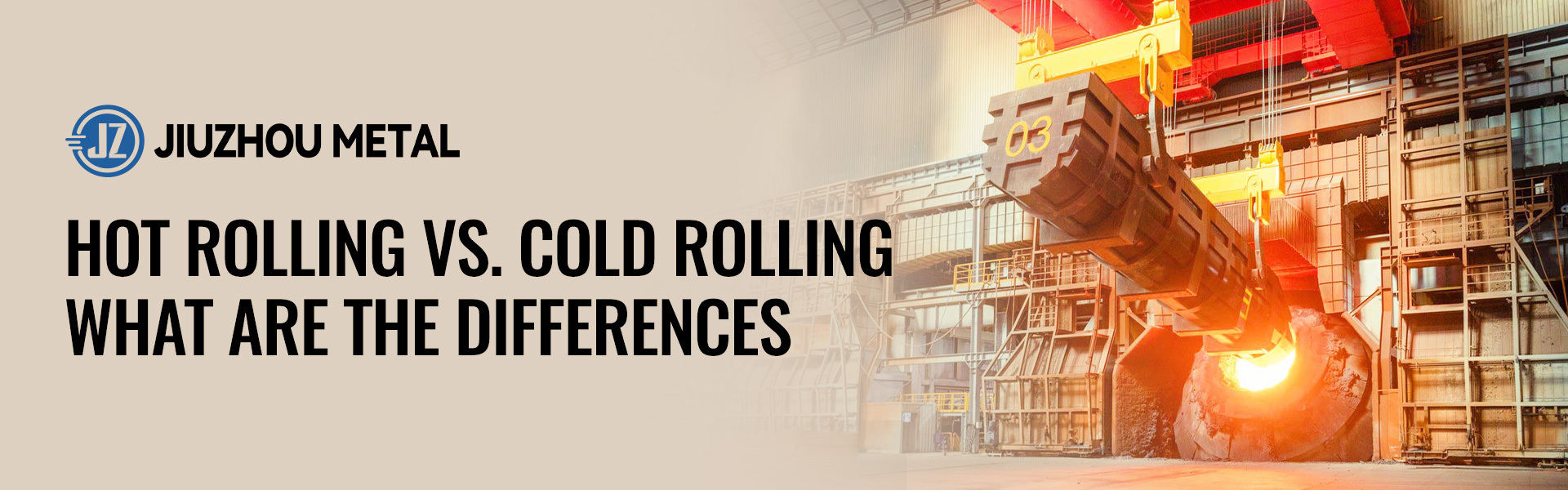
Hot rolling and cold rolling are undoubtedly of the commonly mentioned phrases in the steel industry. In spite of that, how they differ from each other in detail can remain puzzling to many steel buyers. This blog will present a thorough discussion over the differences between hot rolling and cold rolling with regards to steel production.
What Is Hot Rolling:
Hot rolling is relative to cold rolling. Cold rolling is rolling performed below the recrystallization temperature, while hot rolling is rolling performed above the crystallization temperature. Hot rolling uses continuous casting slabs or blooming slabs as raw materials. It is heated by a walking heating furnace and dephosphorized by high-pressure water before entering the rough rolling mill. The rough rolled material is cut into head and tail and then enters the finishing mill, which is controlled by a computer. After final rolling, it undergoes laminar cooling and coiling to become straight coils. The head and tail of straight hair rolls are often tongue-shaped and fish-tail-shaped, with poor thickness and width accuracy, and the edges often have defects such as wavy shapes, folded edges, and tower shapes. After the straight coils are processed by head cutting, tail cutting, edge trimming and multi-pass straightening, leveling and other finishing lines, they are then cut into plates or re-rolled to become hot-rolled steel plates, flat hot-rolled steel coils, longitudinal steel coils, etc.
What Is Cold Rolling:
Cold rolling usually uses longitudinal rolling. The processes of cold rolling production generally include raw material preparation, pickling, rolling, degreasing, annealing (heat treatment), finishing, etc. Cold rolling uses hot-rolled products as raw materials. Before cold rolling, the raw materials must be dephosphorized to ensure that the surface of the cold-rolled products is clean. Rolling is the main process for deforming materials. The purpose of degreasing is to remove the lubricating grease attached to the rolled material during rolling to avoid contamination of the steel surface during annealing, and to prevent stainless steel from carbonization. Annealing includes intermediate annealing and finished product heat treatment. Intermediate annealing eliminates work hardening produced during cold deformation through recrystallization to restore the plasticity of the material and reduce the deformation resistance of the metal. The purpose of heat treatment of the finished product is the elimination of hardening through recrystallization. It also lies in obtaining the required organization and product performance according to the technical requirements of the product. Finishing includes inspection, cutting, straightening, printing, classification and packaging, etc. Cold-rolled products have high packaging requirements to prevent the surface of the product from being scratched during transportation.
To put it simply, cold rolling is processed and rolled on the basis of hot-rolled coils. Generally speaking, it is a process of hot rolling--pickling--cold rolling.
Hot Rolling: Advantages and Disadvantages
Advantages: It can destroy the casting structure of the steel ingot, refine the grains of the steel, and eliminate defects in the microstructure, thereby making the steel structure dense and improving the mechanical properties. This improvement is mainly reflected in the rolling direction, so that the steel is no longer isotropic to a certain extent; bubbles, cracks and looseness formed during pouring can also be welded under the action of high temperature and pressure.
Disadvantages: After hot rolling, the non-metallic inclusions inside the steel are pressed into thin sheets, causing delamination. Delamination greatly deteriorates the tensile properties of the steel along the thickness direction and may cause interlaminar tearing as the weld shrinks. The local strain induced by weld shrinkage often reaches several times the yield point strain, which is much larger than the strain caused by load.
For another, there is residual stress caused by uneven cooling. Residual stress is the internal self-balanced stress in the absence of external force. Hot-rolled steel sections of various sections have such residual stress. Generally, the larger the cross-section size of the section steel, the greater the residual stress. Although residual stress is self-balanced, it still has a certain impact on the performance of steel components under the action of external forces. For example, it may have adverse effects on deformation, stability, fatigue resistance, etc.
Cold Rolling: Advantages and Disadvantages
Advantages: The forming speed is fast, the output is high, and the coating is not damaged. It can be made into a variety of cross-section forms to adapt to the needs of use conditions; cold rolling can cause large plastic deformation of steel, thereby increasing the yield point of the steel.
Disadvantages: Although there is no hot plastic compression during the forming process, there are still residual stresses in the section, which will inevitably affect the overall and local buckling characteristics of the steel. Besides, the cold-rolled steel section generally has an open section, which results in a lower free torsional stiffness of the section. It is prone to torsion when subjected to bending, and torsional buckling when subjected to pressure, resulting in poor torsion resistance.
Hot Rolling vs. Cold Rolling
Appearance and Surface Quality: Since the cold-rolled plate is obtained from the hot-rolled plate after the cold rolling process, and some surface finishing is also performed at the same time as the cold rolling, the surface quality of the cold plate is better than that of the hot plate, so if there are higher requirements for coating quality such as subsequent painting, cold-rolled plates are generally selected. Hot-rolled plates are divided into pickled plates and unpickled plates. The surface of the pickled plates has a normal metallic color due to pickling, but it has not been pickled. The unpickled plate usually has an oxide layer on the surface, which is black, or there is a black layer of iron tetroxide.
Performance: Generally speaking, there is no difference in the mechanical properties of hot-rolled plates and cold-rolled plates in engineering. Although there is a certain degree of work hardening of cold-rolled plates during the cold rolling process, the yield strength is usually slightly higher than hot-rolled plates. The surface hardness is also higher. The specific degree depends on the degree of cold-rolled plate annealing. But no matter how annealed, the strength of the cold-rolled plate is higher than that of the hot-rolled plate.
Processing Requirements: Cold-rolled steel requires high-power rolling mills and low rolling efficiency. In addition, intermediate annealing is required during the rolling process to eliminate work hardening, so the cost is also high.
Hot-rolled steel is easy to roll and has high rolling efficiency. The hot rolling temperature includes the opening rolling temperature and the final rolling temperature. The determination of the opening rolling temperature is mainly based on about 80% of the solidus temperature in the alloy phase diagram, while the final rolling temperature is determined according to the plasticity diagram of the alloy, and it is generally required to be controlled above the recrystallization temperature of the alloy.
Use: Hot-rolled steel is mainly used in the production of steel structures, bridges, ships, containers, and vehicles, while cold-rolled steel is commonly seen in the production of automobile, electrical products, rolling stock, aviation, precision instruments, food cans, etc.
Summary
Overall speaking, hot rolling is relative to cold rolling. Cold rolling is rolling performed below the recrystallization temperature, while hot rolling is rolling performed above the crystallization temperature. To put it simply, a piece of steel billet is heated and rolled several times, then trimmed and straightened into a steel plate. This is called hot rolling. It can significantly reduce energy consumption and reduce costs. During hot rolling, the metal has high plasticity and low deformation resistance, which greatly reduces the energy consumption of metal deformation. Hot rolling can improve the processing performance of metals and alloys, that is, break the coarse grains in the casting state, significantly heal cracks, reduce or eliminate casting defects, transform the as-cast structure into a deformed structure, and improve the processing performance of the alloy.
Cold rolling uses hot-rolled steel coils as raw materials, which are pickled to remove scale and then cold rolled continuously. The finished product is hard-rolled coils. Due to the cold work hardening caused by continuous cold deformation, the strength, hardness, and toughness of the hard-rolled coils increase. The toughness and plastic index drops, so the stamping performance will deteriorate and it can only be used for parts with simple deformation. Hard-rolled coils can be used as raw materials in hot-dip galvanizing plants because hot-dip galvanizing units are equipped with annealing lines.
Previous Page

3D Virtual Pavilion
Douyin Official Media
Flagship Micro Mall
WeChat Public Number
CONTACT US
Mobile: +86-13256761911
Wechat: +86-13256761911
Whatsapp: +86-13256761911
Tel : +86-531-86666666
Address : 1-709-1 Ginza Jingdu International Plaza, No.66 Shunhe East Street, Luoyuan Street, Shizhong District, Jinan City, Shandong Province
Baowu Special steel Products (Shandong) Co., Ltd.