

















I-Beam vs. H-Beam: Comparison and Analysis
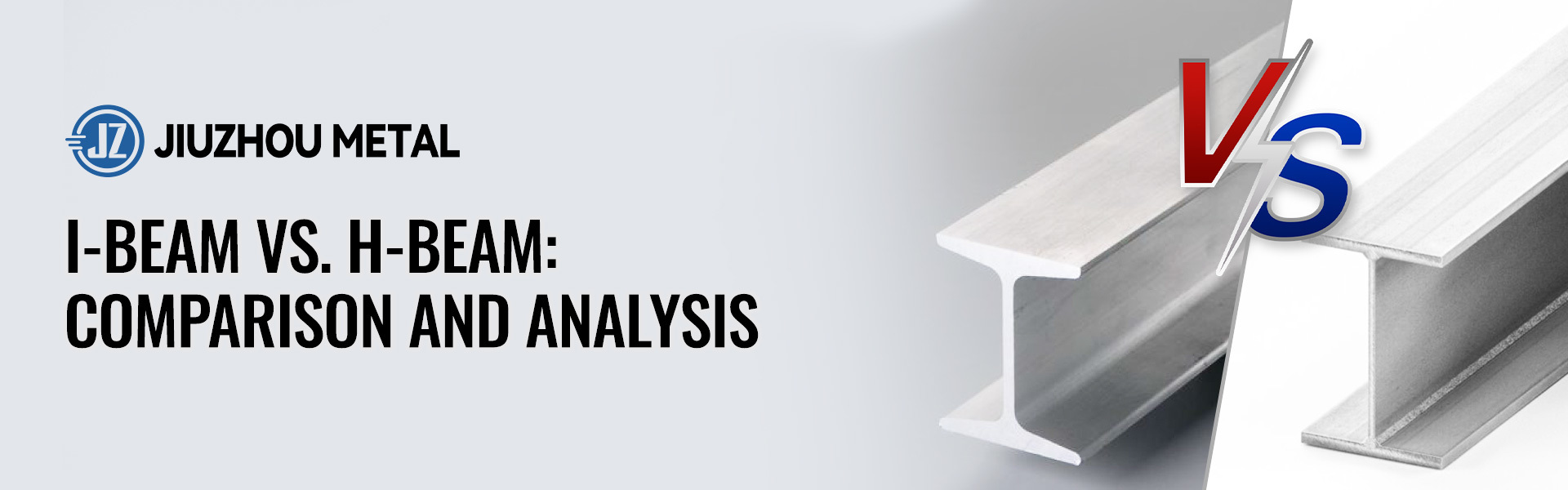
In the field of construction and engineering, the choice of steel is crucial, as it is directly related to the stability, load-bearing capacity and construction efficiency of the structure. Among many steel types, H-beam and I-beam are widely used in various projects due to their unique shapes and properties. However, although they are somewhat similar in appearance and can be easily mistaken for one another, there are significant differences in properties, uses, mechanical properties and construction convenience. This blog will delve into the differences between H-beam and I-beam from multiple dimensions.
Differences in properties and structures
H-beam is a type of steel with a cross-section shaped like the letter "H". Its upper and lower flanges and webs are relatively thin, and the joints are connected by welds. It is mainly used for load-bearing structures and building structures. In comparison, the I-beam is a steel material with a cross-section shaped like the letter "I". It has a relatively thick web and two relatively thin flanges. The connections are usually connected with high-strength bolts and are mainly used in bridges and heavy-duty mechanical structure.
Each point on the cross section of H-beam extends evenly, has small internal stress during rolling, and has high bending strength and load-bearing capacity. In comparison, I-beams have relatively low flexural strength and load-bearing capacity. In addition, H-beam has a large section modulus and is light in weight, which can effectively save materials and reduce construction costs.
Comparison of mechanical properties
Since the cross-section shape of H-beam is reasonable and all parts are arranged at right angles, its bending resistance is significantly better than that of I-shaped steel, about 5%-10% higher. At the same time, the flange of the H-shaped steel is widened and the inner and outer surfaces are parallel, which facilitates the use of high-strength bolts and other connectors for connection, improving the overall stability and load-bearing capacity of the structure. In addition, under the same cross-sectional load, the structural weight of H-shaped steel is 15%-20% lighter than that of traditional steel structures, which is beneficial to reducing the weight of the building and increasing the usable area.
Although the cross-sectional shape of the I-beam also has a certain bending resistance, its torsion resistance is relatively poor due to its narrow flange. However, the I-beam section performs well under direct pressure and has good tensile resistance. In certain application scenarios, such as components that need to withstand large vertical pressure, I-beams still have certain advantages.
Construction convenience and cost effectiveness
The straight flange and right-angle design of H-beam make it easier to operate in terms of welding and splicing, which can effectively save construction time and labor costs. At the same time, H-beam has high precision and small residual stress, and does not require expensive welding materials and weld inspection, further reducing the cost of steel structure production. Compared with welded I-beams, H-beams can save about 30% of steel structure manufacturing costs according to statistics.
Although I-beams also have construction conveniences in some aspects, such as being easy to cut and process. Due to the limitations of their cross-sectional shape, they may require more work when welding and splicing. In addition, the residual stress and deformation of I-beams also require special attention to ensure the safety and stability of the structure.
Fields of application and market needs
H-beams are widely used in industrial building structures, civil building structures, underground construction projects, highway baffle supports, bridges, ships, lifting and transportation machinery and other fields due to its excellent mechanical properties and construction convenience. With the rapid development of the construction industry and the popularity of steel structure buildings, the market demand for H-beams continues to grow.
I-beams play an important role in building structures, bridges, supports, machinery and other fields because of their unique cross-sectional shape and performance characteristics. Especially in some components with high vertical pressure requirements, I-beams still have irreplaceable advantages.
In practical applications, the applicable fields of I-beam and H-beam are also different. Due to its lower cost and good load-bearing performance, I-beam is usually suitable for some construction projects with lighter loads, such as small factories, warehouses, etc. It performs well in the construction of beams, braces and slabs, although caution may be required in some higher load situations.
Summary
To conclude, through the comparison and analysis of I-beams and H-beams, it can be seen that they each have unique advantages and applicable scenarios in terms of structural form, weight and size, strength and stiffness, as well as market demand and development prospects. Selecting the appropriate steel type and specification will help improve the performance and durability of engineered structures.
As of now, there is a wide range of application scenarios for both I-beams and H-beams in construction, bridges, machinery manufacturing and other fields. With the advancement of infrastructure construction and industrialization in many countries, the demand for I-beams and H-beams is consistently increasing. On the other hand, the rapid development of emerging industries has also provided continued growth momentum for the market demand for I-beams and H-beams. What is more, research on materials science, structural mechanics and other aspects of I-beam and H-beam will further promote the innovation and development of their applications. With the technological upgrading and improvement of construction and manufacturing industries, the performance advantages of I-beams and H-beams will be better utilized in the future.
As a well-reputed manufacturer and supplier of steel products with more than 20 years professional experience in this field, Baowu Special steel is committed to manufacturing and offering a wide range of H-beams and I-beams. The company has passed ISO9001 quality management system certification and CE certification. All the products can be executed according to ASTM, JIS, DIN, BS and other common international standards. At Baowu Special steel, we always give great importance to optimizing our products and services, and prioritize the needs of our clients. Nowadays, more and more fellows worldwide seek assistance from Baowu Special steel in meeting their needs for both H-beams and I-beams, and thus fueling their business development!
Previous Page

3D Virtual Pavilion
Douyin Official Media
Flagship Micro Mall
WeChat Public Number
CONTACT US
Mobile: +86-13256761911
Wechat: +86-13256761911
Whatsapp: +86-13256761911
Tel : +86-531-86666666
Address : 1-709-1 Ginza Jingdu International Plaza, No.66 Shunhe East Street, Luoyuan Street, Shizhong District, Jinan City, Shandong Province
Baowu Special steel Products (Shandong) Co., Ltd.